
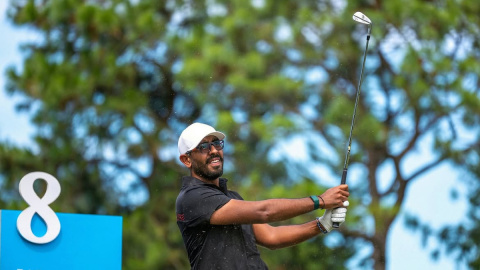
DP World Tour: Indian golf has produced trailblazers who have made their mark on the global stage, but the search for consistent world-beaters continues. India's No. 1 golfer Yuvraj Sandhu believes the country isn't lacking in talent or ambition; the real gap lies in building an ecosystem that nurtures golfers to think and compete like world-class athletes from a young age.
In an exclusive interview with IANS, Sandhu spoke candidly about why Indian golfers struggle to become regular winners on the DP World Tour and PGA Tour, the brutal realities of life on the professional circuit, overcoming a career-threatening slump, and why "pressure is a privilege".

Latest Cricket News
-
1
FIFA WC: Egypt Files Complaint To FIFA, Demands Referees Be Kicked Out After Argentina Loss
-
2
FIFA WC: Giants Survive, Emotional Farewells As QF Line-up Finalises
-
3
Prime Volleyball League Earns FIVB Recognition, Season 5 To Begin From Nov 30
-
4
'India Have Talent But Not The Ecosystem To Produce World Champions': India’s No. 1 Golfer Yuvraj Sandhu
The 29-year-old also reflected on his Olympic aspirations, the changes Indian golf desperately needs at the grassroots level, and the long-term vision required to transform India into a genuine golfing powerhouse.

Excerpts –
IANS: You've won repeatedly on the Indian tour. What do you think is the one thing separating Indian golfers from becoming regular winners on the DP World Tour and PGA Tour?
Yuvraj Sandhu: “I honestly feel as somebody who's had success on the Indian tour and on the Asian tour as well, I honestly feel that there is no dearth of talent or skill or any dearth of hunger in the country when it comes to professional golf and even for, I would say, young amateurs who are wanting to turn professional golfers. So, I don't think that is a part where we need to really tap into where there is a lack of motivation or anything.
One thing I honestly feel is that we can get better in terms of professional golf and the transition from amateur golf to professional golf is the ecosystem around it. When I say the ecosystem, I mean the all-in-all of the infrastructure where the amateur or the professional golfer has a team that works with him or her on the minute or the minutest of details that requires to compete at the international level.
And rather than competing at the international level, think like an international athlete and think like a world-class athlete. Because I think if that begins from a very young age, anybody can be out there playing the best golf of her or his life. I feel infrastructure and ecosystem are the foundation of great golf.”
IANS: If asked your coach and your biggest rival separately, 'What's stopping Yuvraj Sandhu from becoming India's next global golf star?', what do you think each of them would say? And would you agree with either of them?
Yuvraj Sandhu: “My coach would already say that I am the next big star. I am already the next big star of Indian golf. I don't think my coach would say anything else apart from this. Because as a matter of fact, we were just chatting about it yesterday and he repeatedly told me that you are already the next big star that you are. You're already the number one player in the country. So, I don't think that's going to be an issue.
When it comes to my rivals, I hope I don't have any. But even if there is a friendly rival out there, I hope that that rival can compliment me. Because I always believe in being a good human being and a good sportsman. Of course, competition is a part of our lives. We are athletes, we compete for a living. But at the same time, once we're off the golf course and we're not competing, I don't think it should really matter as much. Because sports is a way of life and it teach you just much more than competing out there. It's like a full-on package when it comes to personality building.
So, I think I have personally reached a point where if you ask me about my rival, I would only take out some positives because I have been very observant of the golfers in the DP World, which is the European tour, and higher tours of their positive work ethics or how they are getting better every year, very stably through the years.”
IANS: Every athlete talks about pressure before a final round, but very few explain what it actually feels like. During those last few holes when a title is on the line, what is the loudest voice inside your head and how have you trained yourself to silence it?
Yuvraj Sandhu: “The loudest voice in my head when I'm into that mix or if I'm leading a tournament or if I'm a short pack and I know I can win this, the loudest voice would be, you've done this a couple of times, so how to do it. Just keep your head down and keep doing it.
Because pressure is a privilege. The reason why everybody says that pressure is a privilege, to a very long time, I did not understand what pressure is a privilege actually means. When we all athletes say that pressure is a privilege, it's basically a privilege for you as a human being and as a person to understand what the pressure can get out of you. It is the best that's coming out of you in terms of those pressure moments if you just stick to what your craft is.
So, for me, I take it in a stride where I have been in situations where I've pulled through and I've been in situations where I could have pulled through, but the situations that I could not pull through are the situations that I still remember because had those situations not happened, I wouldn't have learned to win tournaments back-to-back or win tournaments by the margins that I have been winning tournaments.
So, I think pressure is a feeling that if you can generalise it in a good positive way, I think it can just hone so many skills and personalities, and it can show you that competing in the zone is actually real.”
IANS: Golf is slowly finding a stronger place in India's sporting conversation because of the Olympics. When you imagine wearing the India blazer at the Olympics, what responsibility comes with it beyond chasing a medal?
Yuvraj Sandhu: “More than responsibility, I feel pride. I feel honoured to represent the country in whichever tournament I get to play, wearing the Indian blazer or having the Indian flag right in front of my name. And whenever I'm playing the Europa League, I always see the Indian flag soaring high and I always thank myself that I'm here.
Definitely, the Olympics are one game that every athlete dreams about. And there have been moments when I keep thinking about the Olympic Games and, of course, doing well at them. But I feel that again, there are two ways to look at how you can make the Olympic Games a success. For me, it's just something that I'm going to keep repetitively playing and I know that I'm going to be successful there because all I can do right now is just put in work.”
IANS: What's the biggest uncomfortable truth about professional golf in India that fans don't see? Something every player knows but very few openly talk about.
Yuvraj Sandhu: “So, something every player knows about but very few openly talk about. I think the most common truth that spectators, fans and amateurs, they don't see or they don't understand is travelling is fun, but it's not fun when you travel back-to-back weeks for golf tournaments.
One is that. And second is that when you travel professionally for a tournament, that is where you actually feel that golf is an expensive sport. So, there is a misconception of a lot of people saying that golf is an expensive sport. But how is it expensive? It is only when you experience it at the top most, at the most professional level, where that you are making either a certain amount of paycheques or you're not.
So, it's just like, it's a very cutthroat industry where if you slacken even a little bit, you don't get to be out there again. Or everything, every year is different. Every year is like a clean slate, a fresh start for a lot of players out there. You have to keep your cards, you have to keep your status, you have to make a certain amount of points, a certain amount of money to have the honourable merits. And if you don't do that, you have to repeatedly get your professional status again.
So, I think a lot of that comes with experiencing professional golf, which is a lot when you actually are in it, rather than seeing it from a third perspective or a third-person outside view, where you see that, oh, you're travelling, seeing the world, there's glamour, there are Rolexes, there's Omega and all of that. But it takes a lot to be out there, especially just competing. And doing well is at another level altogether.
So, I think that's one uncommon truth that I don't think a lot of the amateurs and the fans and the spectators really, really know about in detail.”
IANS: When was the last time golf completely broke your confidence? What happened, and how did you rebuild yourself?
Yuvraj Sandhu: “I was playing on the Asian tour. This is, this is just right after COVID. It was 2023, if I'm not wrong. Okay. 2023. And I hadn't been playing well. I had been having a little bit of physical issues with my shoulder. And I was overpushing myself into practice. I was exhausting myself in my workouts. I was trying to work out more. I was trying to practise more to get rid of the stretch that I was having.
There was a point in time where I did not make quite a handful of cuts. And I think I was on the verge of losing my Asian tour card, I would say that.
And there was an off-season where I met my team back home again. And I think that's where, that's where the whole team comes in, where you surround yourself, who you surround with, who you surround yourself with. I think that moment when I could spend my time with my team and they could talk to me about some things which are bigger than performances and bigger than finishes and all that.
I think that's where I got a little different perspective of what golf is; golf is definitely important. And there will be days where you play exceptionally well and score well. And that's the, that's the harsh reality of a sport.
And of course there'll be days where you don't really play well, but you finish well. So I think that's also where I learnt to be more patient and a little bit more stable because I was, I was going from a young boy to becoming a man, I guess. And life has its own ways to teach you lessons.
And golf is a beautiful game. The way it teaches you life lessons is very eye-opening. When you look back, I'm very grateful for that, for that, for that situation that I was in where I practically had my back against my wall. And I think if that hadn't happened, then a season like last, last year, a dream season like that, would not have happened because I actually learnt the value of smart work and also letting go. And I think that that was a very big lesson that I needed to learn.
Sports is a way of life. That's why they say everybody should play a sport or try to play a sport. You can be active going on a treadmill, you can be active going to a gym, you can be active while doing your stairs, you could be active while skipping. But when you actually compete, that's when you actually realise what the sport actually is and the importance of sports in your life. It's a very deep meaning; if you ask me, you can talk to me about it for hours. And it's, it's just beautiful if you actually tap into the, the, the thrill of competing.”
IANS: If you had the power to change just one thing about Indian golf tomorrow—whether it's coaching, junior pathways, sponsorship, media coverage or tournament structure—which one change would have the biggest impact over the next decade?
Yuvraj Sandhu: “I would change two of these. One is definitely the junior pathway, the grassroots level, the way children are introduced to the sport, the way parents are introduced to the sport, the way the potential of the sport is shown to juniors to, to literally school-going kids who want to take up the sport and parents who are obviously at that age, parents are in two minds whether we want to let our child pursue a sport like this in our country. I think that is something that I would really, really want to change moving forward.
And the second thing would be the sponsorships and management around the sport, because I honestly feel like we have so much talent and we have so much hunger in terms of golfers who want to go out there and improve themselves internationally and nationally as well. And it's not really expensive to buy equipment, but rather it's more expensive to travel and play and do that for back-to-back weeks and do that year after year.
So I think, I think that is something that would have a major impact going forward for, I'm saying, I'm saying with, with retrospect to players and the gamers as well, because India definitely has the capacity and the capability to host world-class international tournaments. And if it has the capacity and capability to host world-class tournaments, it definitely has the capacity and capability to develop world-class athletes as well.
So I don't see any real issue there. I just see, I just see that we need more and more people with a stronger passion combined with a long-term vision that, that can just press on the pedal and work towards it more positively.”
For Sandhu, success is about far more than trophies and rankings. Whether discussing the pressures of closing out tournaments, the setbacks that shaped his career, or the future of Indian golf, the 28-year-old repeatedly returned to the same themes: patience, perspective, process and purpose.
So I don't see any real issue there. I just see, I just see that we need more and more people with a stronger passion combined with a long-term vision that, that can just press on the pedal and work towards it more positively.”
Also Read: Live Cricket Score
With his sights firmly set on competing with the world's best and one day representing India at the Olympics, Sandhu appears determined to turn that vision into reality, one tournament at a time.